We collected Google Maps ratings for all 50 of the busiest US airports by annual passenger volume, based on FAA traffic data. The 50 airports span from Hartsfield-Jackson Atlanta (the busiest) to John Glenn Columbus (the 50th busiest).
For the initial rating scan, we used the Google Maps search API via Apify to pull the overall star rating and total review count for each airport. This data was collected on April 9, 2026.
We then identified 13 airports with an all-time Google Maps rating of 4.0 stars or below. We chose 4.0 as the cutoff because it represented a natural break in the data – the next cluster of airports started at 4.1. For these 13 airports, we scraped the newest reviews posted since January 1, 2025, pulling up to 5,000 reviews per airport. This produced a total dataset of 48,843 reviews across a 15-month window (January 2025 – April 2026).
For each review with text content (as opposed to star-only reviews), we categorized complaints into 10 topic buckets using keyword matching: Navigation/Layout, TSA/Security, Cleanliness, Staff/Service, Food/Dining, Construction, Parking/Transportation, Crowding, Delays/Cancellations, and Wifi/Charging. A review mentioning “confusing,” “lost,” “signage,” or “long walk” would be tagged under Navigation/Layout, for example. A single review can be tagged in multiple categories, which is why complaint percentages for any given airport sum to more than 100%.
Sentiment scoring was also keyword-based – reviews containing clusters of negative keywords (e.g., “terrible,” “worst,” “avoid”) were flagged as negative sentiment. This is a simpler approach than machine-learning-based NLP sentiment analysis, but it’s transparent and reproducible.
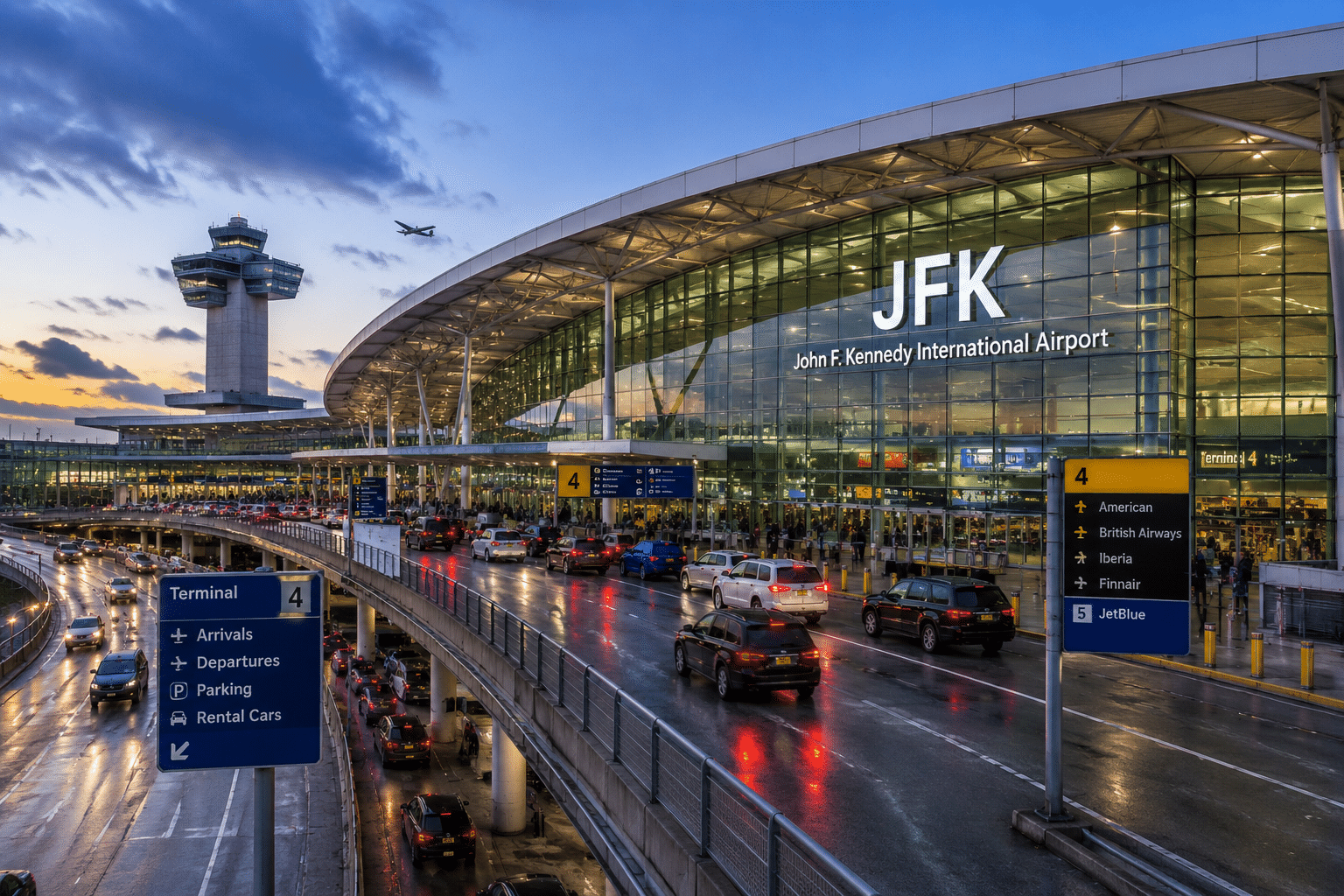
The final ranking is based on the average star rating from 2025-2026 reviews only, not the all-time Google Maps rating. This means an airport with a low all-time rating but improving recent reviews (like Kansas City) can fall off the list, while an airport with a slightly better all-time rating but deteriorating recent reviews (like JFK) can rise.
Limitations: Google Maps reviews skew toward travelers motivated enough to leave feedback, which often means more negative experiences are overrepresented. The 5,000-review cap per airport means we captured different proportions of total recent reviews depending on airport size. Cleveland’s sample (1,076 reviews) is notably smaller than the other airports, so its numbers should be read as directional rather than definitive. Keyword-based complaint categorization captures explicit mentions but may miss implicit complaints. Review dates are based on Google’s display timestamps.
The full dataset, including all 48,843 reviews and the structured analysis, is available upon request.